FinalLeafNumberSet
A data structure in APSIM Next Generation that stores final leaf number (FLN) observations or estimates for a genotype under controlled environmental conditions. These observations quantify the effects of vernalisation and photoperiod treatments on leaf development, supporting genotype-specific parameterisation of phenology models.
Overview
FinalLeafNumberSet defines the final leaf number (FLN) under four treatments in controlled environments (Bloomfield et al. 2023):
- LV: fully vernalised, long photoperiod (>16h)
- SV: fully vernalised, short photoperiod (<8h)
- SN: un-vernalised, short photoperiod (<8h)
- LN: un-vernalised, long photoperiod (>16h)
These four treatments represent the combinations of vernalisation (present/absent) and photoperiod (long/short) that define the phenotypic plasticity of leaf number in response to environmental cues. The data structure is used within the CAMP framework to parameterise genotype-specific responses and calculate vernalisation rate parameters via CalcCAMPVrnRates.
Model Structure
This section describes how this model is positioned within the APSIM framework. It outlines the broader structural and computational components that define its role and interactions in the simulation system.
This model inherits structural and functional behaviour from the following core APSIM components:
Connections to Other Components
This section describes how the model interacts with other components in the APSIM Next Generation framework.
These connections allow the model to exchange information—such as environmental conditions, developmental stage, or physiological responses—with other parts of the simulation system. For a general overview of how model components are connected in APSIM, see the Connections Overview.
This data structure is used by:
| Component | Model | Connection Type | Description |
|---|---|---|---|
| CAMP | CAMP | Parent | Phenology model that uses FLN data for parameterisation. |
| CalcCAMPVrnRates | CalcCAMPVrnRates | Used by | Calculates vernalisation rate parameters from FLN data. |
Model Variables
This section lists the key variables that describe or control the behaviour of this component. Some variables can be adjusted by the user to modify how the model behaves (configurable), while others are calculated internally and can be viewed as model outputs (reportable). For a general explanation of variable types and how they are used within the APSIM Next Generation framework, see the Model Variables Overview.
Configurable and Reportable Properties
This model defines four fixed parameters that are typically derived from controlled environment experiments:
| Property | Type | Description |
|---|---|---|
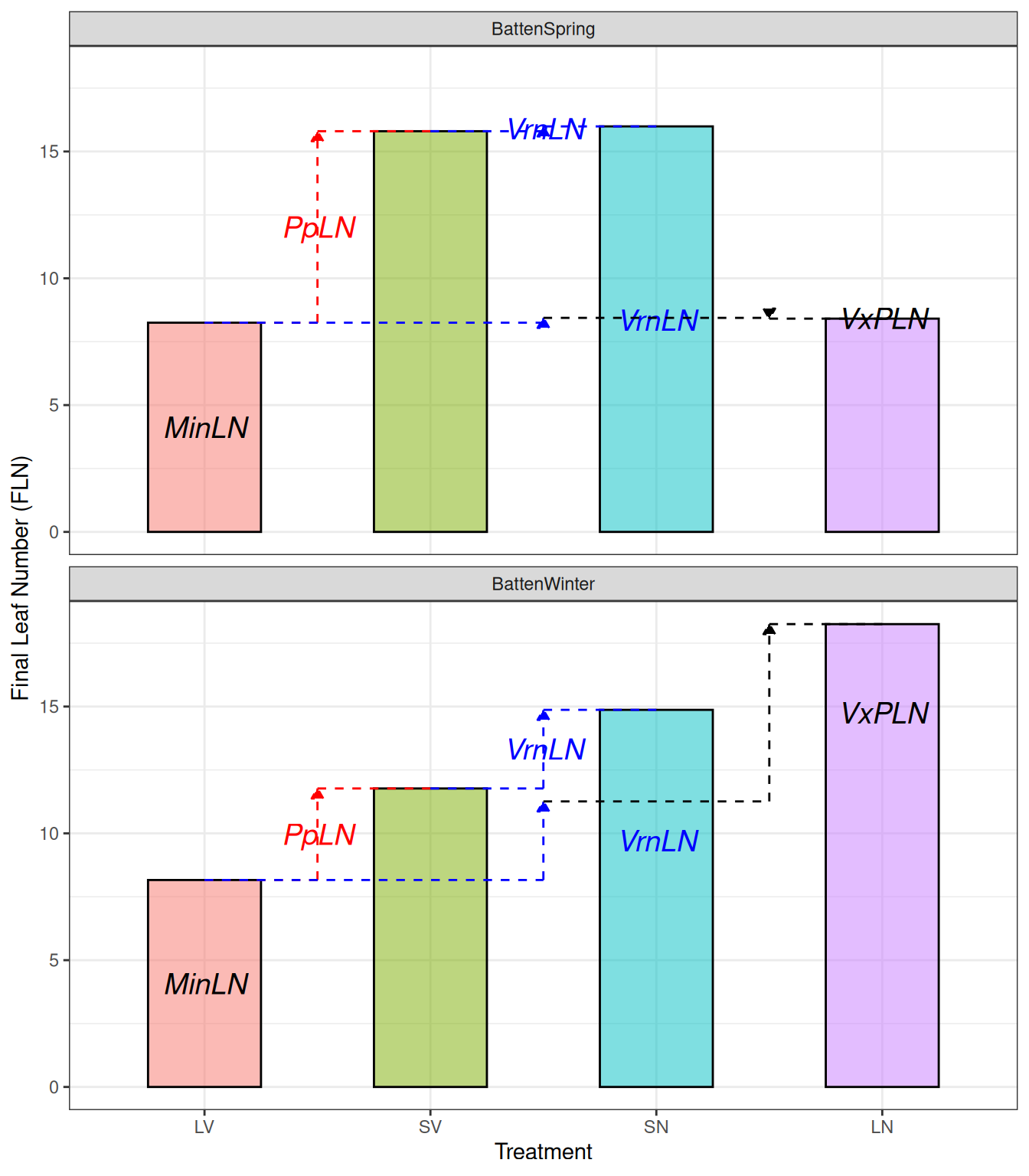
| MinLN | double | Final Leaf Number under full vernalisation and long photoperiod (>16h) |
| PpLN | double | Increase in FLN under short photoperiod (<8h) following full vernalisation |
| VrnLN | double | Increase in FLN when un-vernalised and grown under short photoperiod |
| VxPLN | double | Change in FLN from photoperiod effect under un-vernalised, long-day growth |
Calculated Properties
The model exposes computed FLN values based on defined treatment combinations:
- LV (Long photoperiod, fully vernalised):
\[ \text{LV} = \text{MinLN} \]
- SV (Short photoperiod, fully vernalised):
\[ \text{SV} = \text{MinLN} + \text{PpLN} \]
- SN (Short photoperiod, un-vernalised):
\[ \text{SN} = \text{MinLN} + \text{PpLN} + \text{VrnLN} \]
- LN (Long photoperiod, un-vernalised):
\[ \text{LN} = \text{MinLN} + \text{VrnLN} + \text{VxPLN} \]
These equations represent the phenotypic plasticity of FLN in response to vernalisation and photoperiod interactions.
Reverse Calculation
Conversely, the model parameters can be derived from the final leaf number (FLN) values observed in controlled environment experiments:
- MinLN:
\[ \text{MinLN} = \text{LV} \]
- PpLN:
\[ \text{PpLN} = \text{SV} - \text{LV} \]
- VrnLN:
\[ \text{VrnLN} = \text{SN} - \text{SV} \]
- VxPLN:
\[ \text{VxPLN} = \text{LN} - \text{LV} - \left(\text{SN} - \text{SV}\right) \]
These reverse equations allow researchers to translate controlled environment observations into model parameters that can be used for simulation.
Read-Only Reportable Properties
The model provides the following calculated (read-only) properties representing FLN under the four treatment combinations:
| Property | Type | Description |
|---|---|---|
| LV | double | FLN under full vernalisation and long photoperiod (>16h) |
| SV | double | FLN under full vernalisation and short photoperiod (<8h) |
| SN | double | FLN when un-vernalised under short photoperiod |
| LN | double | FLN when un-vernalised under long photoperiod |
User Interface
FinalLeafNumberSet can be added as a child of a CAMP node in the model tree. Right-click the CAMP node, select “Add Model…”, and search for FinalLeafNumberSet in the Filter Box.
Parameters (MinLN, PpLN, VrnLN, VxPLN) are typically configured based on controlled environment experiments or cultivar characterisation studies.
Practical Example
Below is a summary table for two cultivars including very quick maturity Emu_Rock and very late maturity Sunlamb (Celestina et al. 2023), showing their parameter values and calculated FLN for each treatment:
| Parameter | Emu_Rock | Sunlamb |
|---|---|---|
| MinLN | 6 | 7 |
| PpLN | 1 | 5 |
| VrnLN | 1 | 10 |
| VxPLN | -1 | -5 |
| LV | 6 | 7 |
| SV | 7 | 12 |
| SN | 8 | 22 |
| LN | 6 | 12 |
This figure illustrates the final leaf number (FLN) for the BattenWinter and BattenSpring cultivars under different treatments, including the contributions of each parameter to the final leaf number.
See Also
- Source code: FinalLeafNumberSet.cs on GitHub
References
Bloomfield, Maxwell T., Corinne Celestina, James R. Hunt, Neil Huth, Bangyou Zheng, Hamish Brown, Zhigan Zhao, et al. 2023. “Vernalisation and Photoperiod Responses of Diverse Wheat Genotypes.” Crop and Pasture Science, March. https://doi.org/10.1071/CP22213.
Celestina, Corinne, James Hunt, Haydn Kuchel, Felicity Harris, Kenton Porker, Ben Biddulph, Maxwell Bloomfield, et al. 2023. “A Cultivar Phenology Classification Scheme for Wheat and Barley.” European Journal of Agronomy 143 (February): 126732. https://doi.org/10.1016/j.eja.2022.126732.